
Cleveland Rape Crisis Center Hosts “State of CRCC” March 6, 2026
As National Conversations Around Sexual Violence Resurface, Cleveland Rape Crisis Center Hosts “State of CRCC” to Focus on Local Impact and Long-Term Systems of Care
As national conversations around sexual abuse and exploitation again draw public attention, Cleveland Rape Crisis Center (CRCC) is bringing the focus to where healing and accountability happen every day: at the local level.
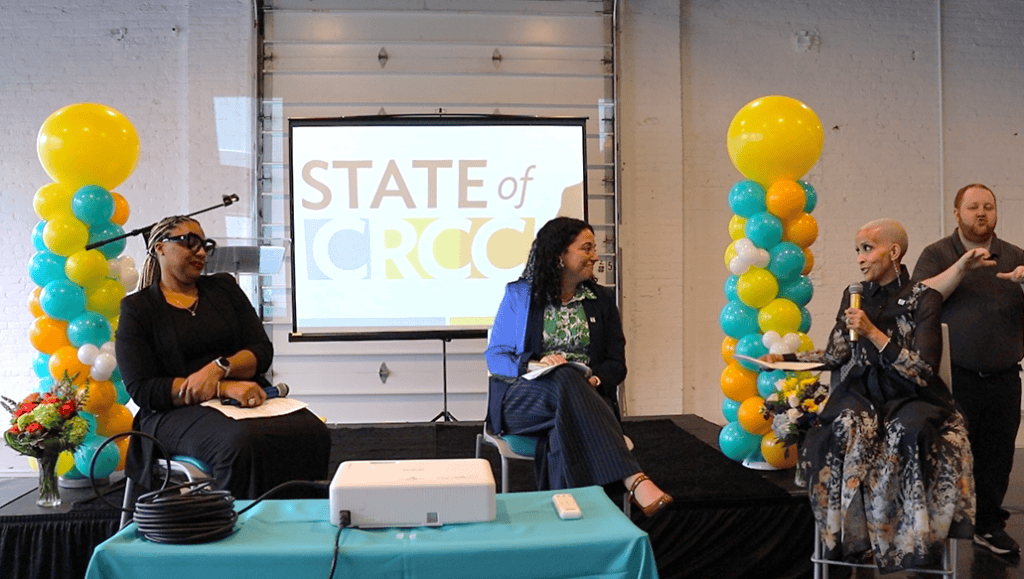
On March 5, CRCC hosted its first-ever State of CRCC, convening civic leaders, funders, advocates, and community partners to provide a comprehensive update on the local landscape of sexual violence response and outline the next chapter of survivor-centered care in Northeast Ohio.
While the event was planned as part of CRCC’s strategic commitment to transparency and community engagement, the renewed national spotlight on sexual violence underscores the timeliness of the conversation.
The event featured a powerful address from Nicole McKinney-Johnson, President & CEO, followed by a live fireside chat with Lisa Radigan, CRCC Board Chair, and Dána Langford, CRCC Vice Chair and President & CEO of Village of Healing.
During the program, CRCC formally unveiled three foundational documents:
- Its 2025 Annual Report
- A newly developed Strategic Plan
- A comprehensive Community Needs Assessment
Together, these documents outline the current landscape of sexual violence response locally, emerging trends in survivor needs, and CRCC’s long-term roadmap for sustainable, survivor-centered systems of care.
“National headlines often spark renewed public attention,” said Nicole McKinney-Johnson, President & CEO of CRCC. “But survivor support is not episodic. It requires infrastructure, prevention, mental health integration, and sustained community investment. The State of CRCC is our opportunity to speak clearly about what that looks like at the local level.”
The organization’s updated data reflects the complexity of today’s survivor landscape. In 2025 alone, CRCC documented more than 15,000 survivor support interactions, provided human trafficking support to 306 survivors and expanded integrated therapeutic services that include suicide risk screening and long-term counseling.
The new Strategic Plan focuses on strengthening prevention efforts, deepening cross-sector partnerships, expanding culturally responsive care, and ensuring workforce sustainability for trauma-informed service delivery.
Moments like this are important because they reflect responsible and forward-thinking leadership,” said Lisa Radigan, CRCC Board Chair. “It’s not enough to do meaningful work — we have to create space to examine it, strengthen it for the long term, and meaningfully engage with the community regarding the needs of survivors. Convening leaders around survivor care reinforces that this responsibility belongs to all of us.”
Held during Women’s History Month, the event highlights women-led leadership shaping one of Northeast Ohio’s primary survivor advocacy institutions.
“Community healing doesn’t happen in isolation,” said Dána Langford, CRCC Vice-Chair and President & CEO of Village of Healing. “It requires collaboration, courageous dialogue, and sustained partnership. Convenings like this signal that our region is committed not just to responding to harm — but to building stronger systems that prevent it.”
While the national climate reinforces the urgency of sexual violence prevention and response, CRCC emphasizes that its work remains steady, long-term, and locally grounded.
“Attention fades,” McKinney-Johnson added. “But the need for survivor-centered systems does not. Our responsibility is to build the infrastructure that allows healing to continue —consistently, responsibly, and compassionately.”
###
About Cleveland Rape Crisis Center
Cleveland Rape Crisis Center (CRCC) provides free, confidential services to survivors of sexual violence and human trafficking throughout Cuyahoga, Lake, Geauga, and Ashtabula counties. Services include a 24/7 hotline, advocacy, counseling, prevention education, and professional training.